CarX Drift Racing 3
- 4.5
- Rating
- 5.00M
- Installs
- Free
- Price

 Analysis by App-foxy
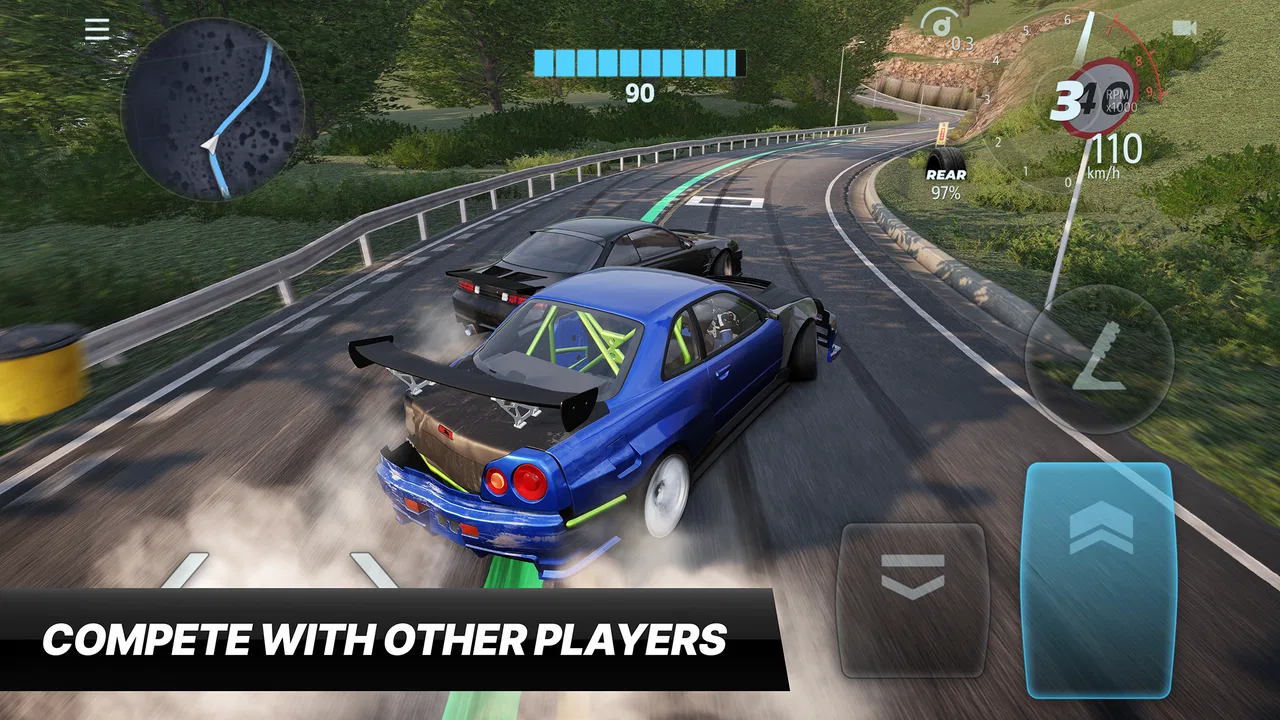
CarX Drift Racing 3 is the kind of racing game that can make a short break disappear quickly. I installed it expecting a familiar mobile drifting experience, but what kept my attention was the way each run asks for a little more control than simply pressing the accelerator and turning. The car’s movement feels like something I have to manage rather than something the game handles for me, and that creates a satisfying learning curve during the first sessions.
Developed by CarX Technologies, this free racing game is aimed squarely at people who enjoy drifting more than conventional lap racing. Its store summary sets the mood with a driver waiting for the engine to reach its limit while judges watch, and that focus is clear in play: the excitement comes from holding a slide, linking corners, and recovering when the rear of the car starts to move too far. The game is rated for Everyone, although the precision it demands may appeal most to players who enjoy practice and repetition.
The early impression is strong because the basic loop is easy to understand. I choose a car, enter a run, try to keep the drift alive, and then look at what went wrong. That last part matters. A failed corner does not always feel random; it usually points to a late steering correction, too much throttle, or an entry that was too fast. When a game makes mistakes readable, I am more willing to retry instead of closing it.
You May Also Like

 Blood Strike: 2.5 Anniversary
Blood Strike’s Loadouts Turn Every Drop Into a Tactical Gamble
A close look at Blood Strike’s custom loadouts: how fast access to signature weapons reshapes its battle royale rhythm, rewards preparation, and narrows the gap between fights.

 Pandora - Music & Podcasts
Pandora’s Music Is Easy to Start, but Harder to Recover
Pandora’s strength is its low-effort path from a seed to a station. Its weak spot is how much confidence it asks you to place in connection, setup, and quiet recovery.

 8 Ball Pool
 Is Built on Rivalries, Rematches, and Routine
A close look at the rivalries, rematches, shared routines, and unanswered safety questions that turn a quick pool match into a persistent mobile community.

 Samsung Music
’s Quiet Strength Is Playing What You Already Own
Its reach comes less from spectacle than from dependable access to a personal library. That simplicity is both the app’s strongest retention engine and its ceiling.

 AccuWeather: Weather Radar
AccuWeather Review: A Quick, Clear Forecast for Everyday Decisions
For everyday plans, the best forecast is the one you can understand quickly. AccuWeather makes rain timing, radar, and local conditions easy to act on, with a few trade-offs.

 Hill Climb Racing
Why Hill Climb Racing Still Turns Crashes Into One More Run
A tiny car, a bumpy hill and one more upgrade: Hill Climb Racing keeps resurfacing because its simple chaos makes every near-miss feel personal.
More From Our News Desk



Why the first week feels so rewarding
During the first week, the biggest appeal is the immediate difference between surviving a corner and actually controlling it. At first, I tended to react after the car had already begun to rotate. With practice, I started preparing the steering earlier and using smaller corrections. That change is more satisfying than simply unlocking another vehicle because it feels like my own ability is improving.
The best way to approach the opening sessions is to resist the urge to chase long, dramatic drifts immediately. I found it more useful to treat each corner as a separate exercise. Enter with a manageable amount of speed, establish the slide, and concentrate on keeping the car balanced until the exit. Once that becomes comfortable, linking the next corner feels much less chaotic.
This also makes the game approachable for two very different audiences. A casual player can enjoy the spectacle of sliding around a course for a few minutes, while a more committed player can study lines and repeat the same section until the movement becomes consistent. I would not describe it as a relaxing racer in the usual sense. Even a short session can require concentration, especially when I am trying to improve rather than merely finish.
One useful habit is to judge a run by its recovery, not only by its best drift. A clean-looking entry followed by a spin often teaches less than a slightly untidy entry that I manage to correct. Watching where the car begins to lose balance helps me identify whether I am asking for too much angle or applying power too early. That makes practice more deliberate and reduces the feeling that progress depends on luck.
The game also benefits from being free to start. I can test whether its handling suits me without committing money first. That is important here because drift controls are personal: some players enjoy a responsive car that demands frequent input, while others prefer a more forgiving racing model. A conventional circuit racer may feel better if I want predictable braking points and clean overtakes rather than continuous correction.
Its audience is already substantial, with more than five million installs and an average rating of 4.5 from roughly forty-two thousand ratings. Those figures suggest that the central driving idea has found a broad audience, but they do not remove the need to try it personally. A strong rating cannot tell me whether I will enjoy the specific rhythm of throttle, steering, and recovery that defines this game.
Small routines that improve the driving
I recommend beginning each session with a few low-pressure runs rather than immediately attempting the hardest available challenge. This gives my hands time to adjust to the current car and prevents one poor opening attempt from shaping the whole session. I also try to change only one thing at a time. If I alter my entry speed, steering timing, and throttle together, I cannot tell which adjustment helped.
Another practical tip is to use the edge of the track as feedback. I do not need to scrape it to learn from it. If the car repeatedly drifts too close to one side, the problem may have started before the corner itself. I may have entered with the wrong angle or carried more speed than the exit could support. Thinking backward from the mistake is often more useful than blaming the final correction.
For short everyday play, the game works well when I set a simple target: complete a clean run, improve one corner, or maintain control for a little longer. Without a small goal, drifting can become repetitive quickly. With one, even a ten-minute session can feel purposeful.
What remains after the novelty fades
The long-term question is not whether CarX Drift Racing 3 can entertain me on the first day. It can. The more important question is whether I still have a reason to return once the initial excitement of learning the handling has passed. In my experience, the answer depends heavily on whether I enjoy self-imposed improvement.
Drifting naturally creates a repeatable challenge. I can revisit a familiar course and try to make the same sequence cleaner, smoother, or more controlled. That is a different kind of replay value from a racer built around collecting opponents or completing a large map. The reward is often in execution rather than discovery, so players who enjoy shaving mistakes from a known route may get more lasting value than players who need constant new scenery.
The game is strongest as a focused skill game. I can open it with a clear purpose, practice a difficult section, and stop after a satisfying run. It is less convincing if I expect an endless stream of fresh activities to keep me surprised. Repetition is part of the design, and that repetition will feel either meditative or tiring depending on how much I enjoy refining technique.
One trade-off is that improvement can be difficult to measure emotionally. A cleaner line may not produce the same excitement as a new car or a dramatic win, even though it represents real progress. I found that setting personal benchmarks helps: fewer corrections, a more stable exit, or a longer uninterrupted sequence. Those goals make the month-to-month experience feel less dependent on unlocking something new.
The current version is 1.10.0, and that gives the game a reasonably established feel rather than the impression of a rough first experiment. Still, a player deciding whether to make it a regular habit should focus on the driving loop itself. Updates can refresh a game, but they cannot change the fact that the core activity asks me to repeat similar movements until they become reliable.
Who will keep coming back?
I can see this becoming a regular choice for someone who enjoys motorsport games but wants the car to feel loose and demanding. It is also a good fit for players who like learning through failure. A person who spends a commute or evening break trying to perfect one sequence may find plenty to do without needing a long uninterrupted session.
It is a weaker match for anyone looking for a straightforward arcade racer with instant success. If I want to steer casually, pass a field of opponents, and feel powerful from the first attempt, this may feel more demanding than expected. I would also point players toward a more conventional racing game if their main interest is realistic lap strategy, overtaking, or broad event variety rather than the technique of maintaining a slide.
For a realistic everyday scenario, imagine having fifteen minutes before an appointment. I can play a few runs, identify one corner that keeps breaking my rhythm, and spend the session working only on that section. The game does not require me to treat every launch as a major event. That makes it suitable for brief practice, provided I am comfortable with the possibility that the session ends with a better understanding rather than a spectacular victory.
Where the routine starts to feel demanding
The same precision that creates satisfaction can also create fatigue. When I am tired, small steering mistakes become more frequent, and the game can stop feeling like a challenge and start feeling like a test of patience. A player who expects to relax after work may find the repeated corrections mentally heavier than expected.
Another source of fatigue is the narrowness of the central activity. Even when the surroundings, cars, or objectives change, I am still returning to the same fundamental task: initiate a drift, hold it, and recover it. That is not a flaw by itself, but it means the game needs to fit my taste. If I need constant mechanical variety, the novelty may fade earlier than it would in a broader racing game.
There is also a natural tension between progression and practice. I may want to move forward, but rushing into more difficult content before my control is ready can turn progression into frustration. I get better results when I accept that repeating an easier route is not wasted time. It builds the timing needed for later challenges, even if the immediate reward feels modest.
The free-to-play structure deserves attention as well. The game is free, with in-app purchases ranging from $1.99 to $79.99 per item. That does not automatically make the experience unsuitable, but it means I would approach spending carefully. I prefer to play long enough to know whether the handling has lasting appeal before buying anything. For a child using the game, an adult should also be aware that optional purchases can change how the experience is managed.
The age rating is Everyone, which makes the presentation broadly accessible, but age suitability and difficulty are not the same thing. Younger players may understand the controls while still finding the repeated failures discouraging. I would introduce it as a game about practice, not as a guaranteed easy win.
Keeping the game from becoming a chore
My most effective maintenance routine is simple: stop after a meaningful improvement instead of continuing until every run feels bad. Ending on a clean corner gives me a reason to return, while forcing attempts after concentration has disappeared usually reinforces poor habits. Short, focused sessions are better suited to this game than long stretches of unfocused grinding.
I also avoid changing cars or settings too frequently while learning a route. Consistency helps me understand whether a mistake comes from my input or from the vehicle’s behavior. Once I can repeat a section reliably, experimenting becomes more useful because I have a stable reference point.
Finally, I treat purchases as optional conveniences rather than part of the basic promise. The free entry is enough to judge the driving. If I do spend, it should be because I already enjoy returning to the game, not because I am trying to solve frustration caused by an unfamiliar handling model.
My long-term verdict
CarX Drift Racing 3 earns lasting space only when drifting itself is the habit you want to build. The first week is easy to recommend to curious racing fans because the handling creates immediate tension and the learning curve feels tangible. I like that a failed run can teach me something specific, and I appreciate being able to use short sessions for focused practice rather than needing a full evening.
After the novelty fades, its value becomes more personal. I would keep it installed because I enjoy returning to a corner and making a small improvement. I would not keep it as my only racing game, since the concentrated drift loop can feel repetitive and demanding when I want variety or a calmer experience.
The game is best for patient players who enjoy control, repetition, and gradual mastery. It is less suitable for someone seeking a broad arcade package or a race that feels satisfying without much practice. CarX Technologies has built a focused mobile racer rather than a universal one, and that focus is both its greatest strength and its clearest limitation.
For me, the deciding test is straightforward: after a few sessions, do I want to retry a difficult corner because I understand how to improve it? If the answer is yes, the free download offers a compelling long-term driving routine. If the answer is no, more progression or optional spending is unlikely to change the basic experience. That makes this a game I recommend selectively, but confidently, to anyone who genuinely enjoys the craft of drifting.
CarX Drift Racing 3 is available as a free game for devices running OS 10 or later, with content suitable for Everyone. Its combination of accessible entry, demanding control, and repeatable practice gives it real staying power for the right player, while its focused structure makes it easy to set aside for those who need broader racing variety.
FAQs for CarX Drift Racing 3
01What are the main features of CarX Drift Racing 3?
CarX Drift Racing 3 offers a realistic drift racing experience with enhanced graphics and physics. Key features include a wide variety of cars, extensive customization options, multiple racing modes, and online multiplayer. The game also supports detailed car tuning, allowing players to fine-tune their vehicles for optimal performance on different tracks.
02Is CarX Drift Racing 3 free to play or does it require in-app purchases?
CarX Drift Racing 3 is free to download and play, but it includes optional in-app purchases. These purchases can enhance gameplay by unlocking premium cars, customization items, and other exclusive features. Players can enjoy the game without spending money, but purchases can provide additional benefits and conveniences.
03What devices are compatible with CarX Drift Racing 3?
CarX Drift Racing 3 is available on both Android and iOS platforms. It requires a relatively modern device to run smoothly due to its advanced graphics and physics engine. Users should check the specific system requirements on the app store to ensure compatibility with their device before downloading.
04How does the multiplayer feature work in CarX Drift Racing 3?
The multiplayer feature in CarX Drift Racing 3 allows players to compete against others worldwide in real-time. Players can join or create rooms, challenge friends, or enter global tournaments. This feature enhances the competitive aspect of the game, offering a thrilling experience with leaderboards and rewards.
05Can CarX Drift Racing 3 be played offline?
Yes, CarX Drift Racing 3 offers offline gameplay, allowing players to enjoy single-player modes without an internet connection. However, features such as online multiplayer and certain events require a stable internet connection. Offline mode is ideal for practice, exploration, and improving skills without interruptions.
Pros
- Realistic physics enhance gameplay.
- Wide variety of customizable cars.
- Stunning graphics and visuals.
- Engaging multiplayer mode.
- Frequent updates with new content.
Cons
- In-app purchases can be pricey.
- Requires a stable internet connection.
- High battery consumption.
- Learning curve for beginners.
- Limited offline gameplay options.

CarX Drift Racing 3
Gallery